
Waste management
Commercial waste duty of care: what businesses need to know
Businesses are responsible for their waste from production to disposal. Understand the duty of care, waste transfer records and how to improve recycling.
Element FM ·
Understand the duty of care
Businesses that produce, store, transport or dispose of waste have a legal duty of care to make sure it is handled safely and responsibly. The responsibility does not end when the waste leaves your site; you must take reasonable steps to make sure it goes to an authorised person.
The Waste Duty of Care Code of Practice sets out the practical steps expected of businesses.
Check who collects your waste
Use collectors who are registered to carry waste and check their registration before handing waste over. Ask where your waste is going and keep that information on file.
- Check carrier registration on the public register.
- Describe the waste accurately, including any hazardous materials.
- Keep waste transfer notes for at least two years (three years for hazardous waste consignment records).
- Store waste securely so it cannot escape or be blown away.
Apply the waste hierarchy
Businesses must take reasonable steps to apply the waste hierarchy: prevent waste first, then reuse, recycle, recover and, only as a last resort, dispose. Separating recyclable materials at source makes this much easier to achieve.
Review bin sizes, collection frequencies and contamination rates. Over-specified services cost money, while under-specified services lead to overflowing bins.
Handle hazardous and specialist waste correctly
Items such as fluorescent tubes, batteries, electrical equipment and some chemicals need separate handling and documentation. Plan for these during maintenance and refurbishment works rather than leaving them to be dealt with afterwards.
Measure and report performance
Ask your waste provider for regular data on tonnages and recycling rates by site. Good data supports cost control, sustainability reporting and conversations with stakeholders about progress.
Simpler Recycling: separating workplace waste in England
Under Simpler Recycling, businesses and other non-household premises in England with 10 or more full-time-equivalent employees have had to separate waste for recycling since 31 March 2025. Micro-firms with fewer than 10 employees are expected to follow from 31 March 2027.
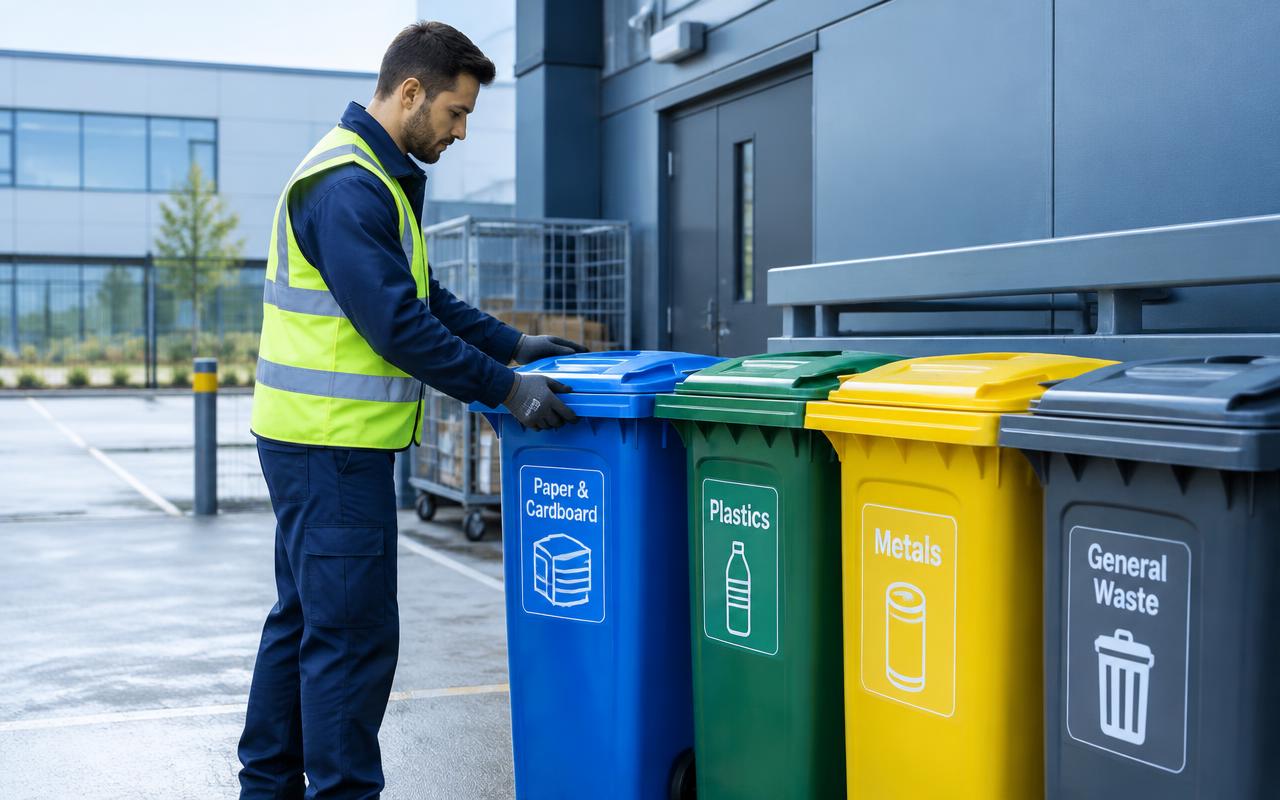
In practice this means keeping dry recyclables (paper and card, plastic, metal and glass) and food waste apart from general waste. Dry recyclables can usually be collected together, but paper and card may need to be kept separate depending on your collector. Rules differ in Scotland, Wales and Northern Ireland.
- Confirm how many employees work at each site.
- Provide separate containers for dry recycling, food waste and general waste.
- Label bins clearly and place them where waste is created.
- Check that your collector's service matches the streams you separate.
What a waste transfer note should contain
A waste transfer note records each handover of non-hazardous waste. It should describe the waste and its List of Waste (EWC) code, how it is contained, the quantity, the place and date of transfer, and the names, addresses and registration details of both parties.
Where the same waste is collected regularly by the same carrier, a single 'season ticket' note can cover repeated collections for up to 12 months. Electronic records are acceptable, and many providers now issue them digitally.
Classify your waste correctly
Correct classification decides how waste can be stored, transported and treated. Most office and retail waste is non-hazardous, but materials such as fluorescent tubes, some batteries, oily rags, solvent-based paints and some electrical equipment are hazardous.
Hazardous waste must not be mixed with other waste and needs a consignment note when it is moved. If you are unsure, ask your waste contractor to help classify it before collection.
Manage waste during works and clearances
Refurbishments, office moves and maintenance generate large, mixed loads in a short time. Agree in advance who is responsible for the waste, which containers will be used, and how materials will be separated for reuse or recycling.
Ask contractors to provide copies of waste transfer and consignment notes for everything removed. Fly-tipped waste traced back to your site can still lead to enforcement action against you.
Store waste safely on site
Keep containers lidded, in good condition and secured against wind, animals and unauthorised access. Position bin stores away from building openings and escape routes, as loose waste can be a fire risk. Overfilled or damaged containers are a common reason for missed collections and complaints.
Sources & further reading
- GOV.UK: Managing your waste
- GOV.UK: Waste duty of care code of practice
- GOV.UK: Simpler Recycling workplace recycling in England
- GOV.UK: Classify different types of waste
General guidance, not a site-specific assessment or legal advice. Requirements vary by premises, equipment and jurisdiction. Check current official guidance and seek competent advice for your site.
Support for your estate